
Searching the Slaughter Court Docket
Slaughter offers no online docket search for the public. There is no town payment portal either. A citation or ordinance question goes straight to the town, which can confirm who currently keeps those local records. A 20th JDC civil or criminal case is a different animal entirely. The East Feliciana Parish clerk's office in Clinton holds that route. Keep one caution in mind, though. Just because a search turns up nothing online does not mean no case exists.
- Check whether the document names the Town of Slaughter, a parish officer, or the 20th JDC.
- For a local ordinance or citation, contact Town Hall and ask which office has the current court record.
- For a state case, consult the clerk's Court Dates calendar for a division and date.
- Use eClerks LA for available statewide index categories or qualifying criminal minute entries.
- Ask the clerk or town custodian to confirm the setting, copy process, and any access limit.
When you ask, bring specifics. A date range, docket number, citation number, or case type all help. The right clerk can then find a Slaughter-related record faster, and you will not be assuming a statewide search covers local town matters.
Slaughter Town Hall Record Contact
Town Hall is the most direct local contact for records. The office sits at 3337 Church Street, Slaughter, Louisiana 70777, and mail goes to P.O. Box 29. Doors are open Monday through Friday, 8:00 a.m. to 4:30 p.m. The published phone number is 225-654-4278, with fax 225-654-1480 and email clerk@townofslaughter.org. The official Town of Slaughter contact page is where those details are maintained, so treat it as the page to verify before you go.
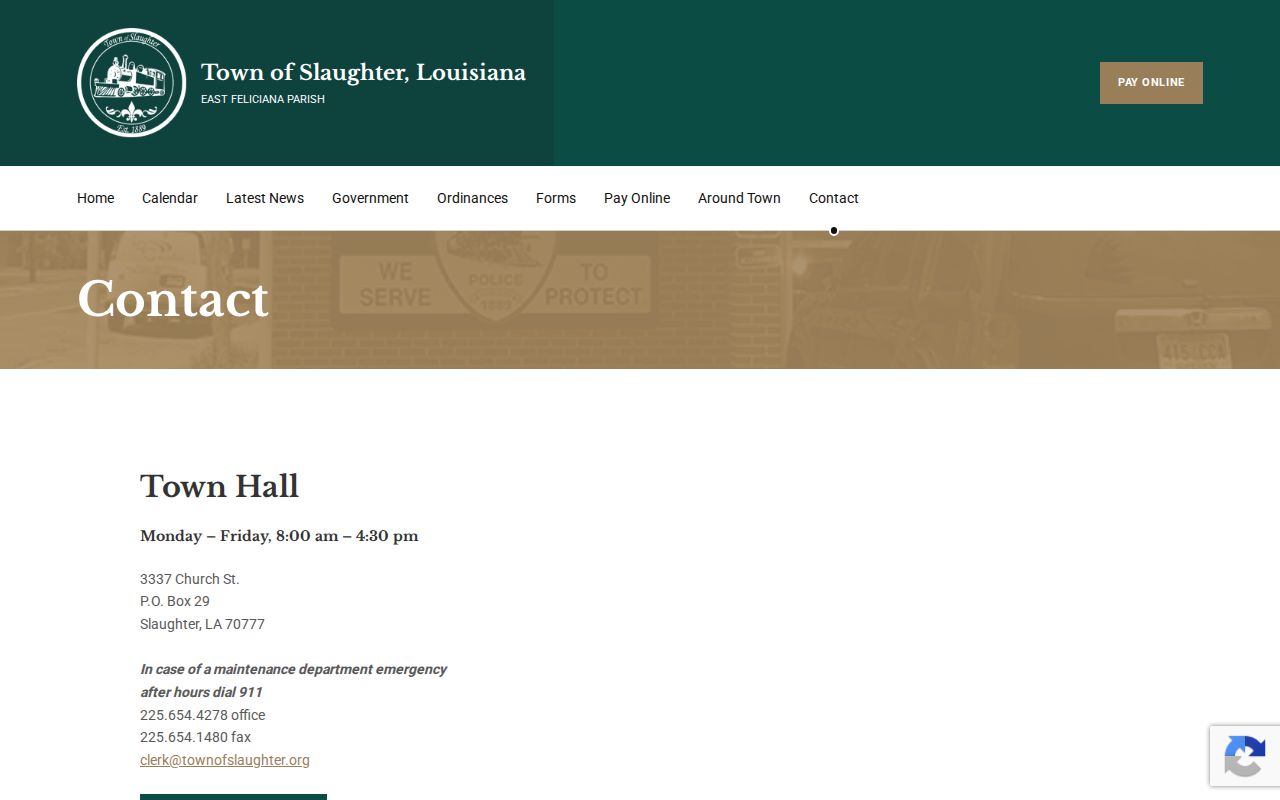
Call the town's published channel before you drive over. That one step tells you who the current records custodian is and what procedure applies, rather than guessing that a town case sits with the district clerk.
Slaughter Municipal Court Basics
The town's own materials reference a mayor's court and local ordinances. Beyond that, Slaughter publishes no municipal-court docket, no judge roster, and no regular court calendar. There is also no public citation lookup and no online payment service. The records may well exist locally. The town simply does not run a dedicated public case-search channel for them. Slaughter's 2020 Census/TIGERweb population is 1,035. That figure only identifies the incorporated place within the city-page set. It says nothing about how many local court cases exist or what type any record holds. The town itself must confirm its custodian.
Slaughter Town Government Record Context
Slaughter incorporated in 1889. The town takes its name from Will and Joe Slaughter. They were the land owners at its founding. Local history like this gives Slaughter its identity, but it does not move a single record. A state trial record stays with the clerk and the 20th JDC system in Clinton. That holds no matter how the town began. The Town of Slaughter government page covers the town's government, ordinances, and mayor's-court context as an official local source.
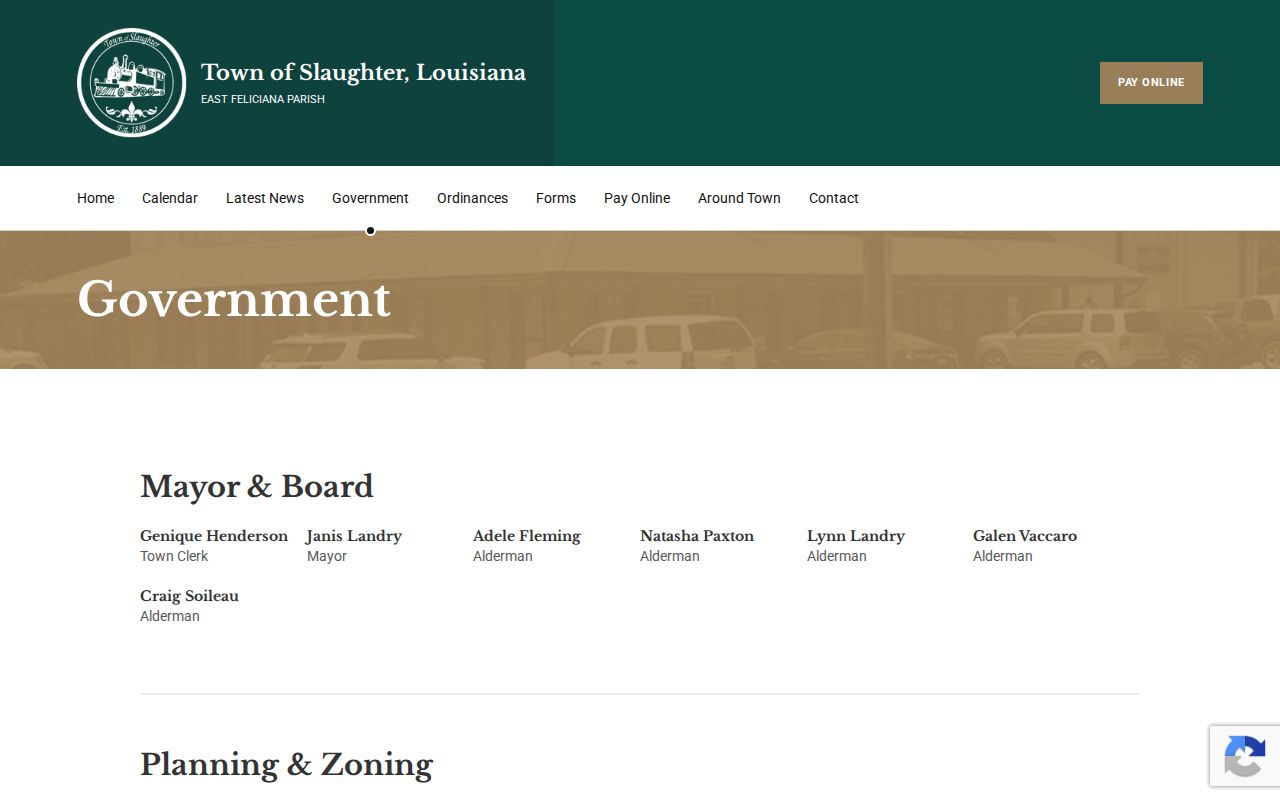
Town government material can point you to the right local office to call. It cannot replace a published docket database or a district-court case file.
Court Dates and Settings in Slaughter
Slaughter posts no recurring mayor's-court schedule. For a local setting, confirm the date with Town Hall directly. State matters work differently. The East clerk's Court Dates page is a monthly 20th JDC index. It links to daily docket detail. It lists Division A under Judge Kathryn E. Jones and Division B under Judge Sydney Picou Walker.
| Date | The scheduled local date confirmed by Town Hall or the state division date shown by the clerk. |
|---|---|
| Division | Division A or B is a 20th JDC field, not a documented Slaughter mayor's-court field. |
| Docket Number | A clerk daily-docket field; no Slaughter format is published in the research. |
| Daily Listing | A state-court date snapshot, not a full filing history or final case result. |
| Change | Call the town or clerk because a setting can move and access can be restricted. |
A date list is only a date list. It cannot prove a hearing happened, a fine was paid, or a case closed. When that level of detail matters, ask for a minute entry, a judgment, or written confirmation from the clerk.
Slaughter State Docket Route
State cases above the town level belong to the Twentieth Judicial District Court of Louisiana. That is the East Feliciana Parish division. The courthouse sits at 12220 St. Helena Street in Clinton. The East Feliciana Parish Clerk of Court, David Dart, works from 12305 St. Helena Street. This clerk does the heavy lifting on paper. The office files and indexes district-court pleadings and assigns docket numbers. It also keeps daily minutes, which are short summaries of proceedings. Anyone may examine records during weekday hours of 8:30 a.m. to 4:30 p.m. Inspection is free. Copies carry a charge. eClerks LA adds a statewide layer on top. Its Statewide Portal offers index categories. Parish Search may involve a subscription or images. Criminal Search reaches qualifying minute entries filed from January 1, 2020 onward. Traffic sits outside that criminal-minute-entry requirement.
Traffic Tickets in Slaughter
Slaughter publishes no ticket lookup. It posts no payment page, no universal fine schedule, and no formal contest procedure. That gap invites a costly mistake. Do not assume a citation written in Slaughter can be paid through the Town of Clinton's vendor. Start with the citation itself. Identify the issuer, then ask Slaughter's current local custodian about a town matter. Parish traffic cases follow the sheriff and State Police instructions instead. The 20th JDC FAQ points local fines to the sheriff's red-brick building at 11315 Bank Street in Clinton. That route is separate from the clerk's court-record function. It is also separate from any unconfirmed Slaughter citation process. Traffic citations also fall outside Louisiana's statewide criminal-minute-entry access mandate.
Slaughter Docket Portal Gap
The Town of Slaughter posts no public docket-search or payment portal. That is the honest gap. Filling it with a guessed vendor link would mislead people. A statewide index hit still needs a check with the office that holds the original. Is the result an index line, a minute entry, or a scanned image? The answer decides where you go next.
The official Town of Slaughter site covers town contacts and local government. It is a solid reference for those needs.
Its public pages handle town contact and government information well. The missing portal is a fact to confirm with the town itself, not a gap to paper over with an unofficial search link.
Where Slaughter Cases Go
Where a Slaughter case lands depends on its type. A town ordinance or local citation may stay with the town's own court-record custodian. State civil and criminal matters go to the East Feliciana Parish division of the 20th JDC, even when the people or events are tied to Slaughter. Justice-of-the-peace matters and town records sit with separate custodians. So do not assume a clerk-held district-court docket covers them.
Docket flow: Slaughter local court record route › East Feliciana Parish clerk records › Twentieth Judicial District Court of Louisiana (20th JDC), East Feliciana Parish division
State appeals move up to the Louisiana Court of Appeal, First Circuit. Federal cases belong to the Middle District of Louisiana, which runs its own record process.
Slaughter Language and Access Records
Language help exists for state cases, and it is worth knowing about before a hearing. The parish clerk lists English and Spanish as standard services. The 20th JDC site explains interpreter and language-service options. Those are state-court services, though. The town has published no matching mayor's-court program.
Call the right office ahead of time. Do this when an accommodation affects a scheduled state court matter. The town posts no official parking map, public terminal description, or full remote-appearance rule, so confirm those details directly.
Slaughter Court Record Access Rules
Match your request to the office that holds the record. Slaughter town material goes to the town's local custodian. State district-court material goes to the East Feliciana Parish clerk. Access has limits, too. Juvenile, sealed, expunged, protected, and court-ordered restrictions can all bar a file. Ask for one specific record rather than everything on a person. That lets the office quote a fee or flag a redaction.
Key rules:
Louisiana R.S. 44:1 includes electronic public-body records within the public-record definition, subject to exceptions.
Louisiana CCP Art. 971 removes an expunged record from public access without destroying it.
Louisiana CCP Art. 973 provides confidentiality rules and limited authorized access after expungement.
Slaughter Census and Court Record Limits
The 2020 Census counted 1,035 people in Slaughter. That number ranks the town among the parish's incorporated places. But it says nothing about courts. It is not a live docket count. It is not a pending-case total or a clue to which office holds a record. For that, follow the issuer. Town for local matters, sheriff for a cited traffic lane, parish clerk for state trial records.
Keeping those routes straight matters, since the state court's documented record route runs through Clinton.
Slaughter Court Record Confirmation
Old local notices go stale. Before relying on one, confirm whether the Town of Slaughter still keeps that ordinance or citation record, or whether it has moved to a new custodian. State files need a different step. Give the parish clerk the date, division, and docket identifier that ties your request to the 20th JDC record.
Why both confirmations? The town posts no public docket or payment portal, so its answer is the only reliable one locally. Slaughter's published town contact covers the local path. The East clerk covers the state-court path. Ask each office only about its own records.
Slaughter Court Record Request Planning
Plan on a phone call or a visit, not an online docket. Slaughter's official materials support a town-contact route, nothing more. Town Hall publishes its address, hours, phone, fax, and clerk email. That is enough to ask a focused question. Ask about a local ordinance record or citation. Give the approximate date, the document type, any citation or file identifier, and whether you want to inspect or copy. Ask the town to name the current custodian and procedure. Slaughter has no public docket or payment portal. A town response is the way to confirm local access.
State requests go elsewhere. The East Feliciana Parish clerk keeps the 20th JDC record route in Clinton. The clerk's public-record materials cover ordinary inspection and copies. The Court Dates page serves as the public scheduling index. A daily docket can pin down a date and division. It cannot prove a complete record or a final outcome. For that, request the clerk-held record by case type, time range, division, or docket number.
Slaughter's 1889 incorporation and its published Town Hall are nice town facts. They do not move state-trial jurisdiction out of Clinton. The town route, the sheriff traffic route, the parish clerk route, and the statewide eClerks route each serve different records. Pick by issuer and case type. A local mayor's-court reference will never stand in for a statewide docket database.
Slaughter Docket Follow-Up
With no public portal, the town itself is the only way to confirm a local Slaughter record. State records keep their documented route through the clerk and district court in Clinton.
Slaughter Court Record Source
Keep whatever the issuing office gave you: the citation, notice, or docket reference. With that in hand, the office can point you to the right local or parish record channel.